
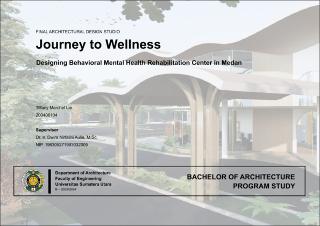
Journey to Wellness Designing Behavioral Mental Health Rehabilitation Center in Medan
| dc.contributor.advisor | Aulia, Dwira Nirfalini | |
| dc.contributor.author | Lie, Tiffany Marchel | |
| dc.date.accessioned | 2025-05-27T05:04:39Z | |
| dc.date.available | 2025-05-27T05:04:39Z | |
| dc.date.issued | 2024 | |
| dc.identifier.uri | https://repositori.usu.ac.id/handle/123456789/104136 | |
| dc.description.abstract | Advancements in technology and lifestyle changes have triggered behaviors that can lead to mental health issues. Mental health is crucial for societal well-being, affecting individual potential, stress management, productivity, and social participation. Negative stigmatization worsens the situation, particularly in Indonesia, impacting quality of life. Therefore, specialized rehabilitation centers are essential for supporting physical and mental recovery. Welldesigned, functional rooms that ensure safety, comfort, and privacy are key. By adopting a Behavioral Architecture approach, these centers can create environments that meet the needs of sufferers, positively influencing their behavior, perception, and feelings. | en_US |
| dc.language.iso | en | en_US |
| dc.publisher | Universitas Sumatera Utara | en_US |
| dc.subject | behavior | en_US |
| dc.subject | holistic | en_US |
| dc.subject | mental health | en_US |
| dc.subject | stigma | en_US |
| dc.subject | rehabilitation | en_US |
| dc.title | Journey to Wellness Designing Behavioral Mental Health Rehabilitation Center in Medan | en_US |
| dc.type | Thesis | en_US |
| dc.identifier.nim | NIM200406104 | |
| dc.identifier.nidn | NIDN0027056302 | |
| dc.identifier.kodeprodi | KODEPRODI23901#Profesi Arsitek | |
| dc.description.pages | 151 Pages | en_US |
| dc.description.type | Karya Tulis Profesi | en_US |
| dc.subject.sdgs | SDGs 11. Sustainable Cities And Communities | en_US |
Files in this item

This item appears in the following Collection(s)
-
Profession of Architect [205]
Profesi Arsitek