| dc.contributor.advisor | Nasution, Mirza | |
| dc.contributor.advisor | Yusrin | |
| dc.contributor.author | Sihaloho, Resbarein | |
| dc.date.accessioned | 2025-07-24T03:13:53Z | |
| dc.date.available | 2025-07-24T03:13:53Z | |
| dc.date.issued | 2025 | |
| dc.identifier.uri | https://repositori.usu.ac.id/handle/123456789/106744 | |
| dc.description.abstract | The development of democracy in Indonesia has increasingly opened up space
for public participation in the process of making public policies, including through the
mechanism of judicial review in the Constitutional Court. One of the important
dynamics in judicial review is the application of the concept of open legal policy where
the constitution authorizes the legislators to regulate dynamic norms in accordance
with the needs of society without explicitly regulating the material of the law to be
formed. For example, Decision No. 55-90-141/PUU-XXI/2023 related to the minimum
age requirement for presidential and vice presidential candidates regulated in Article
169 letter q of Law No. 7 of 2017 concerning general elections.
This research is normative legal research which is legal research conducted by
examining library materials or secondary legal materials. The data sources used
include primary, secondary and tertiary legal materials collected using literature
studies. This research uses a conceptual approach, statutory approach and case
approach.
The inconsistency of the Constitutional Court emerged when it interpreted this
concept differently in three of its decisions, which is Decision No. 55-90-141/PUU
XXI/2023. The inconsistency of the Constitutional Court can be seen from the rapid
and drastic change in stance regarding the application of open legal policy. The
Constitutional Court in Decision No. 55/PUU-XXI/2023 stated that the age issue is an
open legal policy and is the authority of the legislator, but then in Decision No.
90/PUU-XXI/2023 the Constitutional Court inconsistently added new norms that did
not previously exist. Even in Decision No. 141/PUU-XXI/2023, the Constitutional
Court reiterated that the norms related to the age requirements of presidential and
vice-presidential candidates are an open legal policy that must be regulated by the
legislators. This rapid change in the Constitutional Court's stance that is not based on
strong legal justification can reduce public confidence in its independence and
objectivity. | en_US |
| dc.language.iso | id | en_US |
| dc.publisher | Universitas Sumatera Utara | en_US |
| dc.subject | Constitutional Court | en_US |
| dc.subject | open legal policy | en_US |
| dc.subject | constitutional review | en_US |
| dc.subject | age requirement for presidential and vice-presidential candidates | en_US |
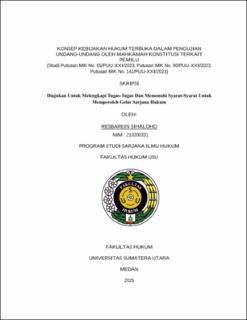
| dc.title | Konsep Kebijakan Hukum Terbuka dalam Pengujian Undang-Undang oleh Mahkamah Konstitusi Terkait Pemilu (Studi Putusan MK No. 55/PUU-XXI/2023, Putusan MK No. 90/PUU-XXI/2023, Putusan MK No. 141/PUU-XXI/2023) | en_US |
| dc.title.alternative | The Concept of Open Legal Policy in the Constitutional Court's Judicial Review of Laws Related to Elections (Study of Constitutional Court Decision No. 55/PUU-XXI/2023, Constitutional Court Decision No. 90/PUU-XXI/2023, Constitutional Court Decision No. 141/PUU-XXI/2023) | en_US |
| dc.type | Thesis | en_US |
| dc.identifier.nim | NIM210200331 | |
| dc.identifier.nidn | NIDN0026127203 | |
| dc.identifier.nidn | NIDN0012067513 | |
| dc.identifier.kodeprodi | KODEPRODI74201#Ilmu Hukum | |
| dc.description.pages | 109 pages | en_US |
| dc.description.type | Skripsi Sarjana | en_US |
| dc.subject.sdgs | SDGs 16. Peace, Justice And Strong Institutions | en_US |