| dc.contributor.advisor | Putra, Yulesta | |
| dc.contributor.author | Lubis, Rima Azizah | |
| dc.date.accessioned | 2025-07-24T06:23:43Z | |
| dc.date.available | 2025-07-24T06:23:43Z | |
| dc.date.issued | 2025 | |
| dc.identifier.uri | https://repositori.usu.ac.id/handle/123456789/107071 | |
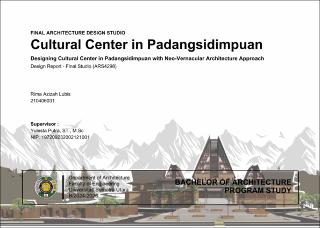
| dc.description.abstract | Culture is a lifestyle that is collectively owned and passed down from generation to generation. Padangsidimpuan has various forms of art and historical sites that represent events and narratives from the city's history. However, currently, the culture of Padangsidimpuan is not widely recognized by the general public due to a lack of awareness regarding local culture and the absence of a dedicated space for the community to engage with their own heritage. This situation serves as the foundation for designing a "Cultural Center in Padangsidimpuan" as a venue for community activities aimed at learning about local arts and culture.In this design, a neo-vernacular architectural approach is employed, which emerges as a response to the need to preserve local identity while adapting to technological advancements and contemporary lifestyle demands. The objective of this design is to address issues related to public interest in the arts and culture.
From the identified issues, it can be concluded that there is a need for a space dedicated to the development of local culture. The implementation of neo-vernacular architecture concepts provides a framework for how visual characteristics can be applied to buildings in a way that adapts to local contexts while preserving cultural identity. This architectural style serves as a bridge between traditional values and contemporary needs, ensuring that the essence of local culture is maintained while accommodating modern advancements.
From the identified issues, it can be concluded that there is a need for a space dedicated to the development of local culture. The implementation of neo-vernacular architecture concepts provides a framework for how visual characteristics can be applied to buildings in a way that adapts to local contexts while preserving cultural identity. This architectural style serves as a bridge between traditional values and contemporary needs, ensuring that the essence of local culture is maintained while accommodating modern advancements. | en_US |
| dc.language.iso | en | en_US |
| dc.publisher | Universitas Sumatera Utara | en_US |
| dc.subject | Padangsidimpuan | en_US |
| dc.subject | Cultural Center | en_US |
| dc.subject | Neo-Vernacular Architecture | en_US |
| dc.title | Designing Cultural Center in Padangsidimpuan with Neo-Vernacular Architecture Approach | en_US |
| dc.title.alternative | Perancangan Pusat Budaya di Kota Padangsidimpuan dengan Pendekatan Arsitektur Neo-Vernakular | en_US |
| dc.type | Thesis | en_US |
| dc.identifier.nim | NIM210406031 | |
| dc.identifier.nidn | NIDN0023097208 | |
| dc.identifier.kodeprodi | KODEPRODI23201#Arsitektur | |
| dc.description.pages | 200 Pages | en_US |
| dc.description.type | Skripsi Sarjana | en_US |
| dc.subject.sdgs | SDGs 11. Sustainable Cities And Communities | en_US |