| dc.contributor.advisor | Hasnida | |
| dc.contributor.author | Sitepu, Grace Angel Natasya | |
| dc.date.accessioned | 2025-09-19T02:05:54Z | |
| dc.date.available | 2025-09-19T02:05:54Z | |
| dc.date.issued | 2025 | |
| dc.identifier.uri | https://repositori.usu.ac.id/handle/123456789/108500 | |
| dc.description.abstract | Emerging adulthood is a crucial phase in development characterized by the
search for independence, including in health decision-making. In the digital
age, the internet has become a primary source of health information, but
often, inaccurate information can lead to confusion and anxiety, a
phenomenon known as cyberchondria. This study aims to analyze the
impact of cyberchondria on help-seeking behavior intention in early adults,
with a sample of 385 respondents from Medan City. Data were collected
using the Cyberchondria Severity Scale (CSS) and the General Help
Seeking Questionnaire (GHSQ) through Google Forms and analyzed using
simple linear regression. The results show that cyberchondria has a
significant effect on help-seeking behavior intention (p = 0.007), although
its contribution is weak (R² = 1.9%), indicating that other factors have a
stronger influence. Descriptive data also reveal that the majority of
respondents prefer informal assistance over formal help. | en_US |
| dc.language.iso | id | en_US |
| dc.publisher | Universitas Sumatera utara | en_US |
| dc.subject | Cyberchondria | en_US |
| dc.subject | Help-Seeking Behavior Intention | en_US |
| dc.subject | Emerging Adulthood | en_US |
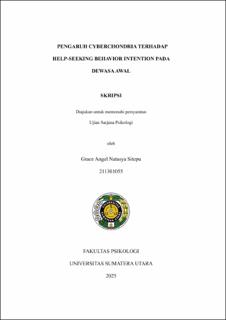
| dc.title | Pengaruh Cyberchondria terhadap Help-Seeking Behavior Intention pada Dewasa Awal | en_US |
| dc.title.alternative | The Impact of Cyberchondria on Help-Seeking Behavior Intention in Emerging Adulthood | en_US |
| dc.type | Thesis | en_US |
| dc.identifier.nim | NIM211301055 | |
| dc.identifier.nidn | NIDN0021086901 | |
| dc.identifier.kodeprodi | KODEPRODI73201#Psikologi | |
| dc.description.pages | 128 Pages | en_US |
| dc.description.type | Skripsi Sarjana | en_US |
| dc.subject.sdgs | SDGs 3. Good Health And Well Being | en_US |